The demo created momentum.Production is the wall.
Prototype with anything. Turning it into a product takes surfaces, state, schedules, and evals, so Runtype packages that whole layer as an AI product runtime for early teams.
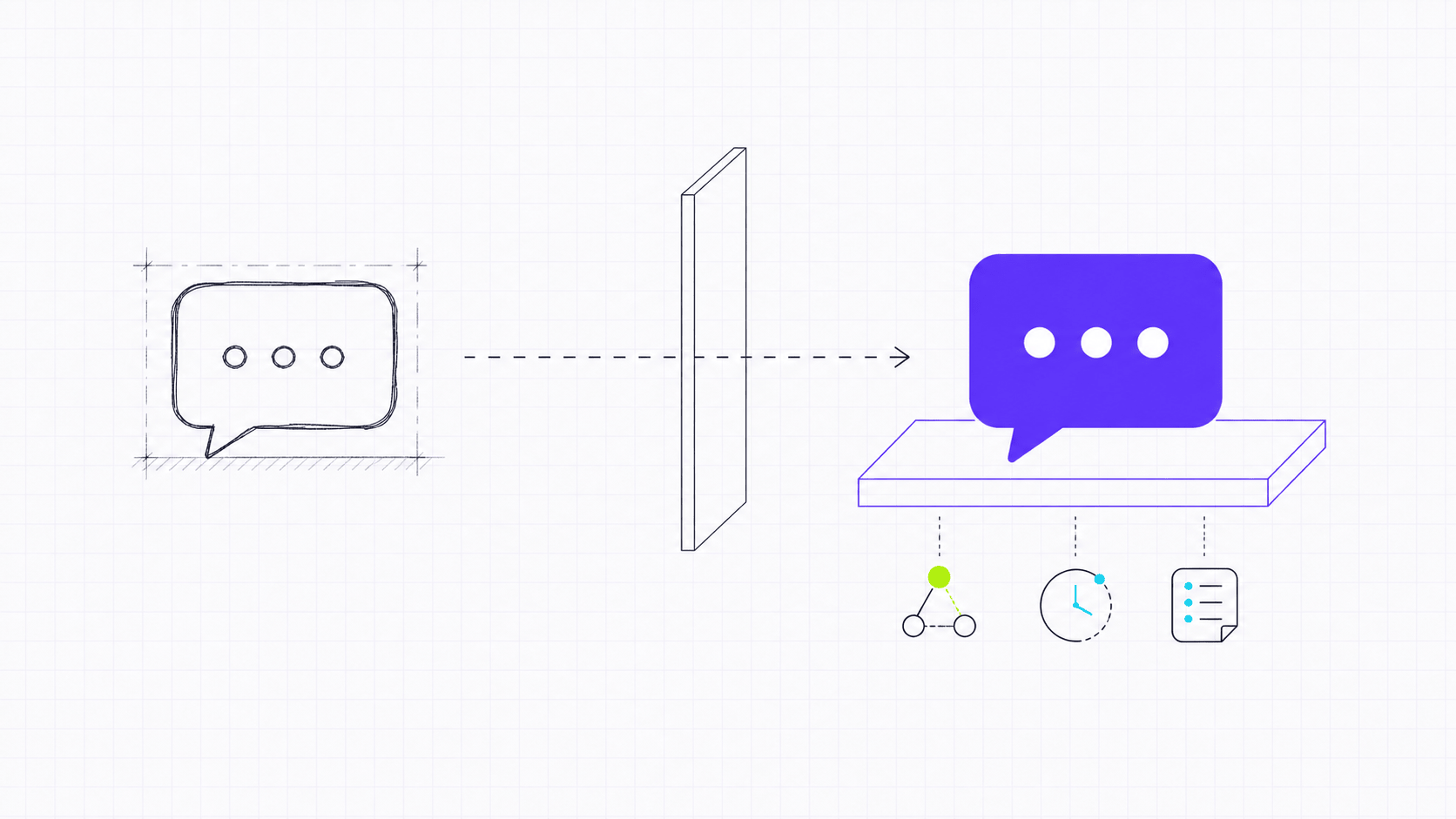
You’re three weeks from launch. The list says otherwise.
The capability works. But users need auth, a streaming UI, memory, schedules, error handling, and logs, and your design partners need it reliable. Every week spent building runtime is a week not spent on the product. And the stack you hand-roll today is the debt you’ll service when the model landscape shifts next quarter.
A polished surface users trust
Memory that survives the session
Schedules for the recurring jobs
Structured outputs your code can parse
Logs for when production misbehaves
Evals before you swap models
How AI startups lose their speed.
The prototype was fast because it skipped everything production requires. The danger is rebuilding that missing layer yourself: slowly, badly, and at the cost of your actual roadmap.
The vibe-coded demo
Built in a weekend, runs on a laptop, wows the design partner. It proves the idea. It is not the product, and the distance between the two is infrastructure, not intelligence.
The infrastructure detour
Auth, SSE streaming, state, retries, queues, a chat UI. Two months in, you’ve built a worse version of a runtime instead of two months of roadmap.
The moving target
Models, frameworks, and best practices change monthly. Every infrastructure choice you hard-code is a long-term bet your runway shouldn’t be making.
Products teams ship in their first weeks.
These are the shapes early AI products actually take, each one launchable on the runtime without a platform team.
The MVP agent product
Your core capability behind a polished chat surface with memory, auth, and streaming, live in front of design partners while the idea is still hot.
Customer-facing assistant
An assistant embedded in your existing product that answers from your data and acts through your APIs, with usage you can actually trace.
Internal ops copilot
The agent that runs your own company (support triage, CRM hygiene, weekly metrics) and doubles as your reference implementation.
Automated research and reporting
Scheduled agents that gather, synthesize, and deliver structured reports to email or Slack. A full product with zero frontend.
Everything around the model call, handled.
Your differentiation is product logic: what the agent knows, decides, and does. The runtime supplies the rest.
A product surface on day one
Surfaces
A polished, streaming, themeable chat surface, plus Slack, email, API, MCP, and SMS. Embed it with a script tag or React component instead of building frontend infrastructure.
Own only your product logic
Agents + flows
Agents for judgment, flows for deterministic orchestration. The logic that makes your product yours is the only thing you maintain; execution, retries, and streaming are the runtime’s job.
Memory without a data layer
Records
User and session state, long-lived memory, and generated artifacts, persisted and queryable without designing a storage architecture first.
Ship model changes fearlessly
Evals
A regression suite per capability. Swap providers or upgrade models weekly, run the evals, and ship, without finding regressions through churned users.
The recurring jobs every AI product grows
Schedules
Digests, syncs, monitoring runs, re-engagement. Every AI product accumulates scheduled work. Here it’s a primitive, not a cron server you stand up at 1 a.m.
Debug production from day one
Logs
Full execution traces for every run: inputs, steps, tool calls, outputs. When a user reports something weird, you look it up instead of trying to reproduce it.
Two ways to spend your next two months.
The hand-rolled stack and the runtime converge on the same checklist. The difference is who builds it, and what your team ships in the meantime.
Common questions
Will we outgrow it?
The API is HTTP and SSE, with TypeScript SDKs, a CLI, and MCP support. Your product logic lives in portable definitions (agents, flows, tools), not in code welded to our internals. You scale by configuration, and you’re never locked out of your own logic.
Can we use our own models and keys?
Yes. Multi-provider routing across OpenAI, Anthropic, Google, xAI, open source, and more. Start on platform keys today, bring your own keys when you’re ready, with no re-architecture either way.
How fast can we actually ship?
If you have a working prototype, the remaining work is mapping it onto primitives: logic into agents and flows, integrations into tools, delivery into surfaces. That’s days of configuration, not months of infrastructure.
Is this just another framework to learn?
No. Frameworks give you building blocks and leave you to host, operate, and scale them. Runtype is a managed runtime: execution, state, security, and deployment are handled. You write product logic; the platform runs it.
What this costs at real volume
Unit economics and the prototype-to-production gap, before either one becomes a surprise.
How to work out what one AI conversation actually costs you
How to turn one provider invoice into cost per turn, per conversation, per customer and per resolved task, with the retries, tools and evals included.
GuideHow to get from an impressive demo to something on-call can support
The gap list between an AI demo and a supportable feature: identity scoping, secrets, budgets, logs, evals, rollback, escalation, alerts and a runbook.
GuideHow to cut LLM spend without making the product worse
Rank LLM cost optimization by risk to output: measure first, trim context, cache the prefix, cap loops, route by task class, then downgrade the model.
ExplainerHow to price an AI feature when your cost is variable
Seat pricing assumes flat marginal cost. Five ways to price an AI feature when it does not: bundled, seat uplift, credits, usage-based, outcome-based.