
The prototype took a week.Production took the quarter.
Launch AI chat, copilots, agents, and workflows across web, Slack, API, and email on a production runtime your team doesn’t have to build from scratch. The roadmap gets the feature, and engineering skips the platform work.
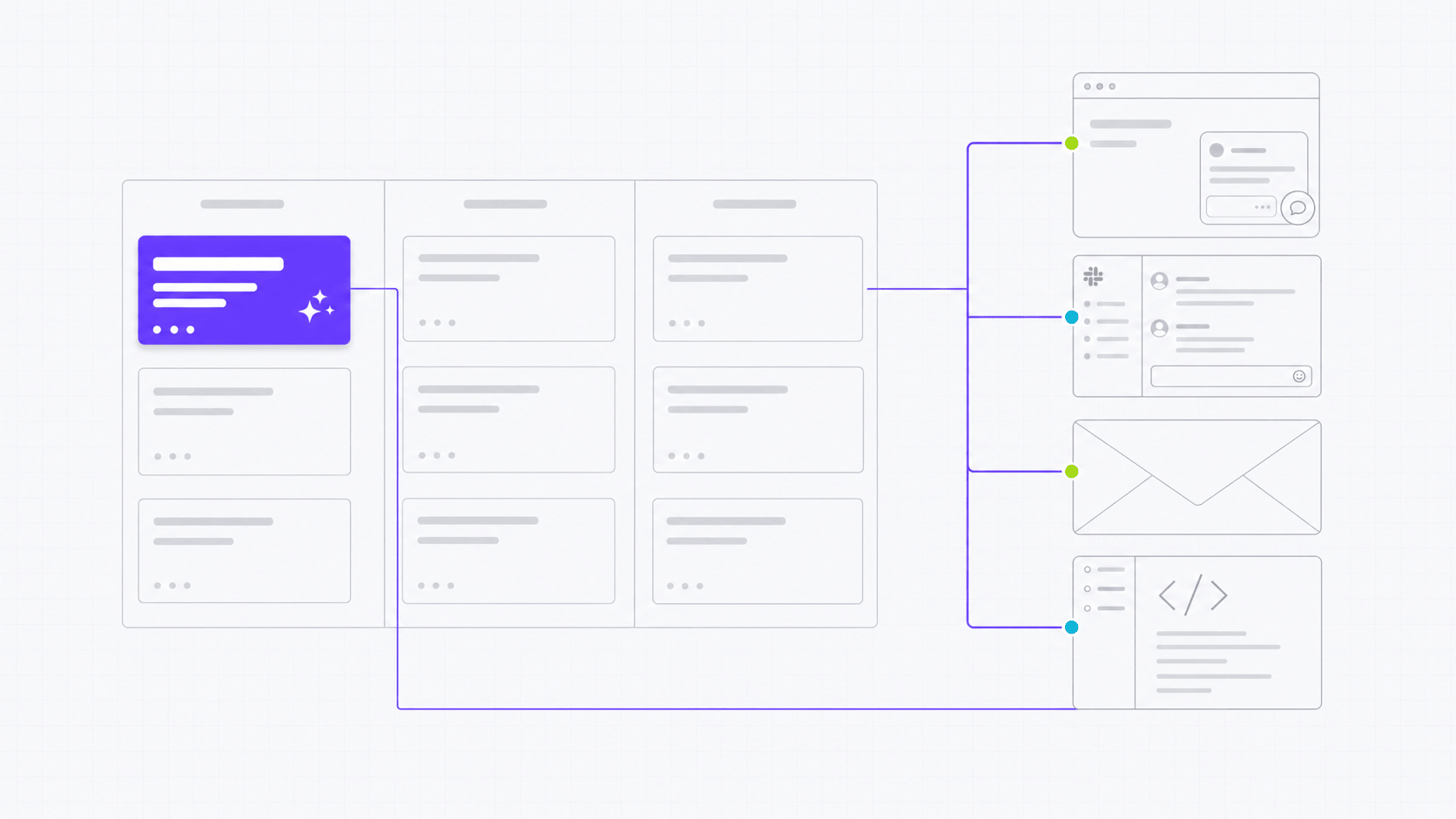
The AI feature isn’t the bottleneck. The infrastructure around it is.
Your team can prove the concept quickly. The delay comes from everything after: deploying to a second channel, handling credentials safely, making the behavior reliable, and coordinating frontend, backend, and AI orchestration. That coordination cost is what kills roadmap velocity.
A second channel without a second project
Credential handling that passes review
Behavior that repeats in production
Cost controls before finance asks
Logs for when something goes wrong
A way to test before models change
Three ways AI features stall.
The demo lands, the launch date is set, and then the same three problems show up between pilot and production.
Surface fragmentation
The feature works in one place. Product wants it in Slack, in the app, behind an API, and triggered by email. Each channel becomes a separate engineering project.
Security overhead
Real AI features need real credentials. Every integration needs token management, credential isolation, and audit trails. That is weeks of platform work per feature.
Behavior inconsistency
The demo impressed everyone. In production, the same input produces different results. Without structured execution, reliability becomes a full-time job.
Less coordination. More shipping.
The runtime handles orchestration, tool execution, deployment, and security. Your team focuses on the product logic: what the AI does, not how it runs.
One feature, many channels
Surfaces
Build the capability once and deploy it to web chat, Slack, API, email, and more. Each surface has independent configuration, so adding a channel is a product decision instead of an engineering sprint.
Security handled at the platform level
Protected parameters
Credentials are hidden from the AI model and injected only when a tool runs. Your team doesn’t build credential management per feature. It’s built in.
Reliable, repeatable behavior
Agents + flows
Agents run with cost budgets and iteration controls. Flows execute with structured logic, branching, and error handling. The feature behaves the same way every time it runs.
Context that survives the session
Records
User and session state, long-lived memory, and generated artifacts are persisted by the runtime, so the assistant remembers the customer without a storage project.
Proof before something changes
Evals
Test capabilities against expected results before a model swap or prompt change reaches users. Quality becomes a check the team runs, not a complaint that arrives later.
Answers when someone asks what happened
Logs
Every execution is traced: inputs, steps, tool calls, outputs. When support escalates or a stakeholder asks, the answer is a lookup rather than an investigation.
Start with one. Expand when it lands.
These are the features product teams launch first, each one shaped to start on a single surface and grow.
Embedded product assistant
Help users onboard, troubleshoot, and complete tasks inside your product. Starts as web chat and extends to email and API when support needs grow.
Internal operations copilot
Give your team faster access to workflows, triage, and repetitive tasks. Deploy in Slack where the team already works, and add a dashboard surface later.
Multi-channel support agent
One agent handles customer questions across web chat, email, and Slack. Same logic, same quality, same audit trail, and three fewer projects for engineering.
Scheduled digests and reporting
Agents that gather, summarize, and deliver updates to email or Slack on a schedule. A visible win that ships without touching your frontend.
The roadmap impact.
The difference shows up in what engineering spends its weeks on, and in how many launches the same team gets through in a quarter.
Common questions
Do we need to rebuild everything to use Runtype?
No. Start with a single feature on a single surface. The architecture is designed to expand: add capabilities and surfaces incrementally.
Can engineering still control implementation details?
Yes. Runtype handles the runtime platform (orchestration, security, deployment, execution). Your engineers control the product logic: what the AI does, which tools it uses, and how it responds.
How does this affect our existing infrastructure?
Runtype is additive. It doesn’t replace your backend or frontend. It’s the AI product layer: your team calls it via API, embeds it via widget, or connects it via MCP. It integrates with what you have.
Can we launch in one place and expand later?
That’s the core model. One capability, one surface. When the feature lands, add more surfaces without rebuilding the logic.
Knowing whether it actually works
How teams decide an AI feature is ready to launch, and how they tell whether anyone is using it afterwards.
A QA process for AI features that a team without ML engineers can run
A four-stage QA process for AI features: an exploratory pass, a frozen regression set, a weekly sampled review with a rubric, and one rollback metric.
GuideHow to measure whether your AI feature is actually being used
Message counts rise whether an AI feature helps or not. Six steps to a metric set that survives scrutiny: completion, repeat use, escalation and outcome.
GuideHow to build your first eval set from real production conversations
A repeatable loop for mining eval cases from production traces: stratified sampling, PII and consent handling, tenant isolation, labeling, and set size.
GuideHow to catch a model upgrade that quietly degrades your product
How to test a model upgrade before it ships: pin or route the model id, hold the suite constant, read per-case diffs, shadow live traffic, then gate.