Healthcare AI doesn’t fail at the prompt.It fails at operations.
Workflows that touch patients leave no room for improvisation. Runtype is the AI product runtime that gives healthcare SaaS, pharmacy operations, and care-journey teams audit trails, approvals, and predictable behavior from the first deployment.
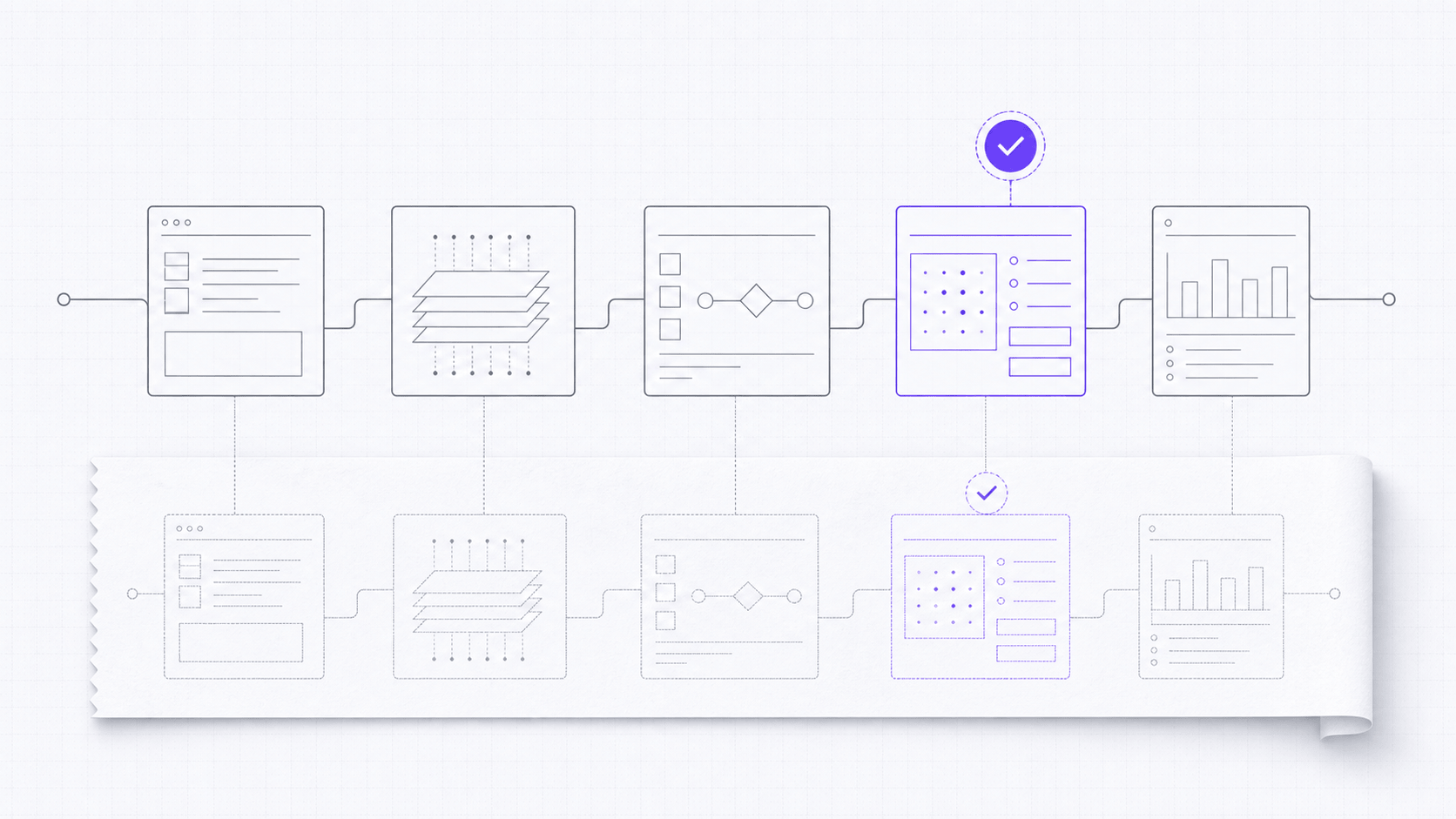
The pilot worked. Production is a different discipline.
Most healthcare AI stalls in the gap between a promising experiment and a capability staff rely on every day. The model was never the blocker. What’s missing is operational: who approved this output, what data did it see, what happens when the input is malformed at 2 a.m., and can you prove all of that later.
An audit trail for every execution
Human sign-off before patient contact
Fixed, repeatable paths for sensitive steps
Scoped access to patient context
Regression tests before model changes
Escalation paths when confidence drops
A pilot proves capability. An operation proves control.
The difference between a scripted pilot and a production healthcare capability is everything that happens around the model call.
Three stages, three different failure modes.
Healthcare teams rarely fail to prove AI capability. They fail to operationalize it, and each stage of that journey breaks in its own way.
The experiment
A clinician pastes a transcript into a chatbot and the note comes back excellent. It proves capability, not safety: no context controls, no review step, no record of what happened.
The integration
An engineer wires the model API into the stack. It works until the model updates, the prompt drifts, and nobody can say what changed, when, or for which patients.
The operation
Daily use means schedules, retries, approvals, scoped access, logs, and a way to test changes before they reach staff. That is a product layer, and most teams don’t have one.
The control layer, already built.
Every operational requirement that keeps healthcare AI in pilot purgatory maps to a capability that already exists in the runtime, on a platform with encryption at rest and in transit, per-organization data isolation, and audit trails by default.
Nothing reaches a patient unreviewed
Approvals
Human approval steps gate any output before it goes out. The reviewer approves in chat, Slack, or email; the workflow continues; the sign-off is permanently on the record.
Prove what happened, later
Logs
Every execution is recorded: inputs, steps, tool calls, outputs, and decisions. When someone asks why the system did what it did, the answer is a trace, not a reconstruction.
No improvisation on sensitive paths
Flows
Fixed step sequences where the path must never vary, and agents only where judgment genuinely belongs. You decide which is which, per step.
Patient and case context, scoped
Records
State, memory, and artifacts scoped per patient, case, or journey, so each workflow sees exactly the context it should and nothing it shouldn’t.
Change models without changing behavior
Evals
Test suites run against your real workflows before a prompt or model change ships. An upgrade becomes a tested release instead of a silent behavioral shift.
Care journeys that run on time
Schedules
Follow-ups, adherence checks, and journey triggers fire on schedule without a human remembering to run them, with every run logged.
First workflows worth operationalizing.
Start with one high-value clinical or operational workflow. Make it safe to run every day. Then expand.
Transcript-to-note copilot
Turns consult transcripts into structured draft notes, with the clinician approving every note before it enters the record. Consistent formatting, full trace per note.
Pharmacy journey agent
Manages refill reminders and adherence check-ins on a cadence your team defines, and escalates to staff when a patient response needs human judgment. Every step lands on the audit trail.
Intake and routing agent
Structures inbound patient requests, classifies urgency against fixed rules, and routes to the right queue. Low-confidence cases are escalated, never guessed.
Clinical operations briefing
A scheduled digest of operational data (volumes, exceptions, pending reviews) delivered to leads each morning, built from the same logged pipeline every day.
Common questions
How does Runtype handle sensitive data?
Sensitive data is encrypted at rest and in transit, each organization’s data is isolated, and credentials are injected at execution time so models never see them. Records are scoped per case, every execution leaves a complete audit trail, and hybrid execution can keep tools and data inside your environment while reasoning runs in the cloud. For your specific compliance requirements and deployment constraints, talk to us, and we’ll map them honestly rather than wave a badge.
Can a human stay in the loop?
Yes, structurally, not as a habit. Approval steps are part of the workflow definition, so a clinician or operator must sign off before designated outputs proceed. The approval itself is logged.
Can we control which model is used where?
Per step. Use different models for different steps, route across providers, and bring your own keys. Evals let you verify behavior before any routing change reaches staff.
Do we have to replace existing systems?
No. Runtype tools call your existing APIs and systems of record. It is the workflow and control layer on top of what you run today, not a replacement for it.
Controls a review will ask about
Approval gates, redaction and audit questions that come up long before a clinical workflow goes live.
How to keep PII out of your LLM logs
Redact customer PII on the write path into agent traces: what counts as PII in a chat payload, detector trade-offs, stable tokens, retention tiers and tests.
GuideHow to add a human approval step before an agent does something irreversible
How to gate an AI agent's irreversible actions behind a human decision: classify tools by blast radius, pause the run, show the exact call, and record it.
ExplainerGuardrails that still hold when the model changes
Which AI guardrails break when you swap models, which hold, and a test procedure that proves the difference before the new model reaches customers.
ExplainerHow to map an AI feature onto the NIST AI RMF and the EU AI Act
A feature-level mapping from NIST AI RMF functions and EU AI Act obligations to controls you configure, plus the artifact that evidences each one.