Commerce AI that ships to the storefront.Not the sandbox.
Shopping assistants, ops copilots, and content workflows that run against the live catalog. Retailers, commerce platforms, and Shopify and BigCommerce agencies build them on Runtype, the AI product runtime that holds up through peak season.
Where commerce AI projects come apart.
The pattern repeats across retailers and the agencies that serve them: the concept demos well, then the realities of catalogs, channels, and seasons take over.
The proof of concept
A product-recommendation demo against a CSV export. Real catalogs change hourly, inventory matters, and the demo has never met either.
The channel sprawl
The assistant works in web chat. Then come requests for email, SMS, and the ops team’s Slack, and every channel becomes its own integration project.
The peak-season test
A silent model update shifts tone across twelve thousand product descriptions in November. Without evals and approval gates, customers find out before you do.
Commerce AI has to touch everything, and stay on brand doing it.
A commerce capability isn’t real until it works against the live catalog, holds the brand voice at scale, survives a model update during peak season, and gives merchants a way to review before anything goes live. That operational surface, not the model, is why most retail AI never leaves the deck.
Live catalog and order data in context
Brand-safe outputs at catalog scale
Merchant review before publish
Customer context across sessions
Schedules that match merchandising rhythms
One capability across web, email, and SMS
Built for catalogs, channels, and seasons.
The operational requirements of commerce AI map directly to capabilities already in the runtime, with no bespoke infrastructure per storefront or per channel.
Storefront APIs as agent capabilities
Tools + MCP
Catalog, order, and customer APIs (Shopify, BigCommerce, or custom) become first-class agent tools. The agent reads live inventory and acts through the systems you already run.
Brand-safe at catalog scale
Structured outputs
Outputs checked against your format for product content, recommendations, and classifications. Ten thousand descriptions in the right format and register, or the run fails loudly, never quietly off-brand.
Merchants approve before it goes live
Approvals
Review gates inside the workflow: the merchandiser approves the batch in Slack or email before anything reaches the storefront. Sign-off is logged, not assumed.
Shoppers and operators, remembered
Records
Customer context across sessions and product context across runs. The shopping assistant remembers the cart conversation; the ops copilot remembers last week’s exceptions.
Merchandising runs on a calendar
Schedules
Weekly merchant briefings, content refreshes, price and competitor checks, all scheduled to match the retail calendar instead of waiting for someone to run them.
Peak season without surprises
Evals + logs
Brand-safety and accuracy tests run before any prompt or model change ships, and every execution is traceable when a merchant asks why.
Commerce products to ship first.
Start with one workflow, prove it against the live store, then expand across channels and storefronts.
Catalog content engine
Generates and refreshes product descriptions, SEO copy, and merchandising content in brand voice: format-checked, batch-approved, published on schedule.
Merchant weekly briefing
A scheduled digest of sales movement, inventory alerts, and content opportunities delivered to the merchant’s inbox: the heartbeat of a managed-service retainer.
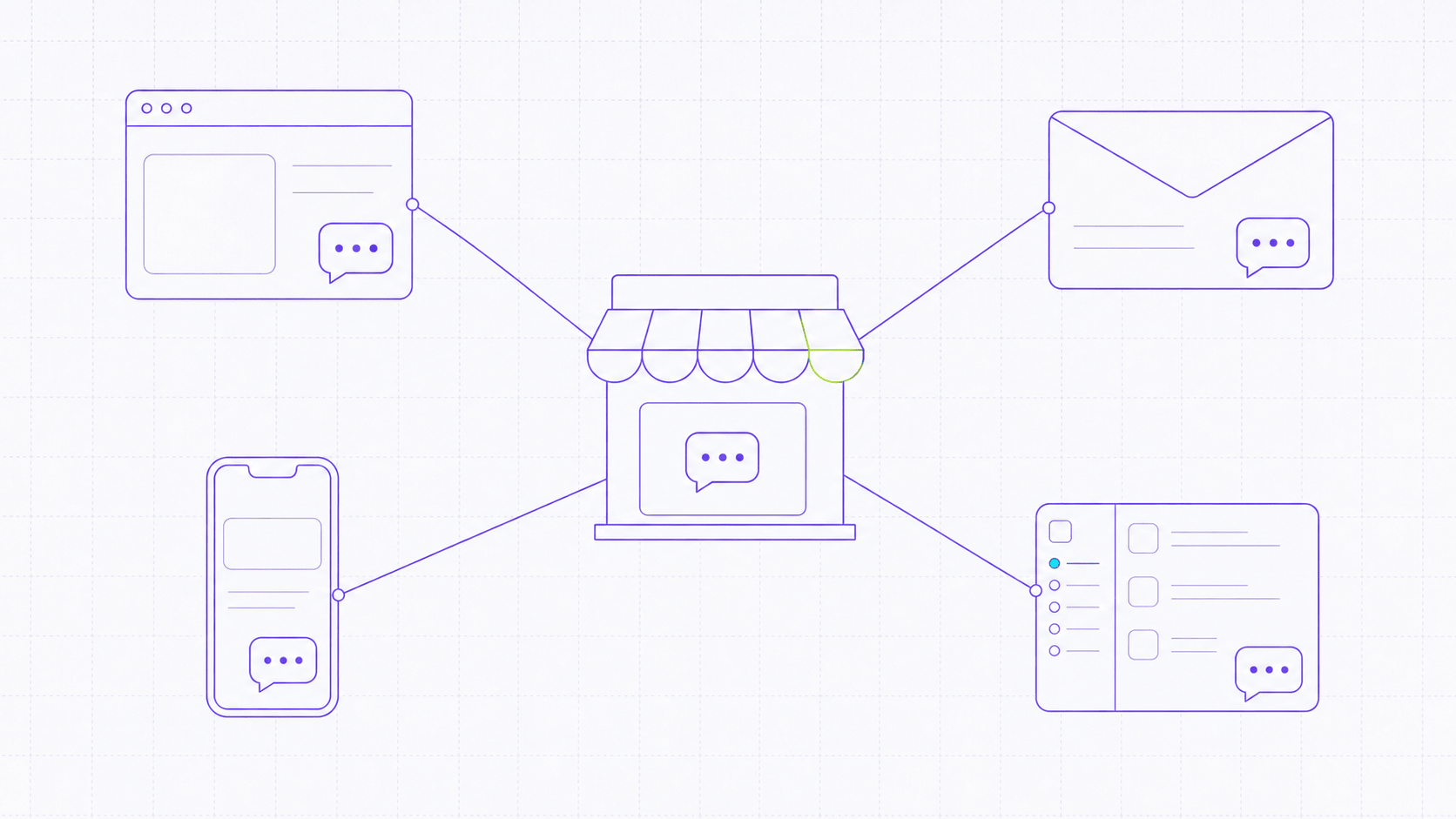
One capability, every channel — or one project per channel.
The channel-by-channel approach turns each surface into a separate build. The runtime approach makes channels a property of one capability.
Common questions
Does it work with Shopify and BigCommerce?
Yes. Storefront and admin APIs become agent tools, and custom platforms connect the same way: anything with an API. See the Shopify fraud analyzer in our examples gallery for a working reference.
How do we keep outputs on brand?
Three layers: structured outputs constrain format, brand guidelines live in the agent and flow definitions, and automated tests check voice and accuracy before any change ships. Approval gates catch what automation shouldn’t decide alone.
Can one assistant cover web, email, and SMS?
Yes, that’s the point of surfaces. One capability deploys to web chat, email, SMS, Slack, and API simultaneously, with the same logic, tools, and records behind each channel.
We’re an agency. Can we resell this to merchants?
Yes. Build the capability once, configure it per merchant with their catalog, brand voice, and channels, and operate it as a managed service. Each merchant gets scoped records and credentials.
Agents that touch commerce systems
Wiring storefront and back-office APIs into an agent without letting it improvise on price, stock or brand voice.
How to get JSON out of a model that you can actually put in a database
Layer the guarantees: schema design, provider structured-output modes, validation at the boundary, retrying with the error, and the record that still fails.
GuideHow to turn an internal workflow into a tool an agent can call
Turn a CRM lookup or an internal service into an agent tool: task-shaped granularity, typed inputs, server-side credentials, timeouts and a read-only rollout.
GuideHow many tools is too many, and what to do when you pass the limit
Why tool selection degrades past twenty tools, and how to fix it: measuring accuracy, merging duplicates, namespacing, tool search and per-task pools.
ExplainerMCP or a plain API: which one should you expose to agents
MCP and a REST API answer different questions. How they differ on discovery, schemas, auth, state and streaming, and when to expose one, the other or both.